|
|
|
|
|
|
|
|
|
|
|
|
|
|
 |
| UNRAVELING
RIVEN by Tim Forcade CGW contributing editor
Computer
Graphics World February 1998: Millions of people, computer literate and otherwise, have heard of the CD-ROM game Myst, originally published in 1993 and developed by Robyn and Rand Miller, the brothers behind Cyan (Spokane, WA). Indeed, Myst has sold more than a million copies, and to date it is the best selling CD-ROM game of all time. Myst set new criteria for what a computer game could be, with its contemplative pace, total lack of fast-twitch violence, mysterious non-goal-directed game play, and - as most who played the game would agree - graphics so striking, they exceeded any previously produced in a game.
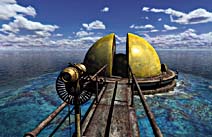
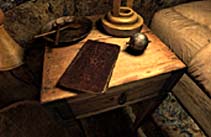
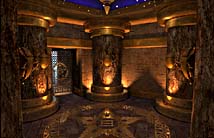
With such a legacy to surpass, it's no wonder that Cyan took four years to produce Riven, the sequel to Myst. But as the saying goes, it was worth the wait. Riven is truly stunning and is even more refined and well-developed then Myst. For those not familiar with Myst and Riven, both titles are an experience in the Tolkienesque D'ni civilization - an ancient and fantastic culture in which physical worlds called Ages can be created by writing their detailed descriptions in specially prepared books. In Myst, players found themselves on an island attempting to unravel a mystery spanning several Ages and involving Atrus and his two sons. Riven's story is built upon Myst, with Atrus reappearing to charge the player with the objective of capturing his father, Gehn, and freeing his wife, Catherine, from her prison island somewhere in the Age of Riven. The graphics in Myst were, at the time, groundbreaking. The photorealistic 3D rendered world displayed a level of detail and beauty not known to games. There was also no interface per se; the images filled the screen, and players wandered through by clicking to go up, down, left, and right. But as beautiful as the graphics were in Myst, Riven goes further. The imagery and its accompanying soundtrack are cinematic. As you explore Riven, each frame makes you feel as if you are in a unique space that could actually exist. Scenes have amazing texture, depth, and presence. Lighting, both outdoor and indoor, is not only convincing but often provides a theatrical feel that establishes and holds each set's mood. Riven's oceans ripple and reflect their environs naturally. Its craggy terrain and caves display marvelous rocky detail. The live action sequences and animation integrate seamlessly. "Rand and Robyn knew Riven would be bigger than Myst", says Jason Baskett, CG artist/animator. "They wanted the next level of graphic reality." And they got it. The Cyan artists' attention to detail throughout the title is astonishing. For instance, common shortcuts such as bump maps were rarely used in lieu of geometry. This means essentially every object and sub-object are fully modeled right down to the individual details, such as the screws. Whereas many CG images are created using single-sided models that accommodate just one camera view, Riven's models are equally detailed from 360 degrees. "There are things on the backsides of models that the player will never see," says Tim Greenberg, CG artist/animator. To achieve this level of graphics, Cyan's first major decision was to switch from the Mac-based Vision3D from Strata, which was used to develop Myst, to the SGI version of Softimage 3D and Mental Ray (both from Softimage) for rendering. The reasoning was due to Softimage's ability to handle more complex geometry and its superior texture capabilities. Mental Ray, a shader-based renderer, would be need for lighting, shadows, and optical effects - not to mention its distributed rendering and allowance for creating custom shaders. All of the game's objects were modeled in Softimage using B-splines or NURBS with only the islands themselves created using polygonal geometry. "B-Spline geometry provided more control for most objects while the polygonal geometry enabled us to break the large island objects apart to facilitate world assembly and more efficient rendering" says Baskett. Each island was produced from intricate hand drawings which were scanned, detailed in Photoshop, and saved as gray scale maps. These were then used in Softimage as displacement maps to create the island topology. Everything else was individually modeled and textured. As the Cyan artists worked on each object, they would consider how it might function if real, how its function would affect its look, and then devise its geometry and texture maps accordingly. For example, in real life a lever would look worn around its joints and handle, so the artists would build in that level of detail. Creating and applying Riven's image maps was actually more complicated than the modeling process. Initially, Cyan traveled to New Mexico to take photos - hundreds, which all had to be catalogued - to serve as the texture bases. Next, artists spent hours in Photoshop painting, editing, and perfecting each texture. In addition to texture maps, bump and transparency maps were used. In fact, working with image maps was so essential to the process that alongside each artist's Indigo II Extreme was a PowerMac with 73 MB of RAM used mostly for working on texture maps in Photoshop. Artists would tweak textures in Photoshop and apply them to the 3D models in Softimage. Next they'd render the textured model, evaluate how it looked, and return to Photoshop to make corrections and start the cycle all over again. Incidentally, Riven's maps range in size to as large as 80MB, though a typical map averages around 2MB.
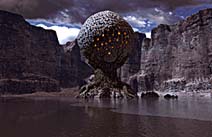
Lighting Riven's numerous scenes was complex as well. Some scenes required as few as four lights, but occasionally, a scene would need more than 100 lights to achieve the effect Cyan artists were seeking. Exterior lighting consisted of four Infinite lights (a light source with direction but no apparent position): a shadow casting sunlight, a fill light opposite the sun, a ground bounce light, and a blue-sky bounce light. The interior shots presented much more complex lighting problems, often requiring numerous shadow casting area lights found in Mental Ray. Area Lights produce soft, natural-looking shadows by projecting light from a 2D or 3D object rather than from the single-point sources common to most CG programs. Cyan's numerous custom shaders provided much of the unique and natural look of the game. Shaders are small programs that plug-in to a renderer, such as Mental Ray, and expand its capabilities. Karl Stiefvater, CG technical director, created several suites of shaders that Cyan artists used to produce realistic lighting, water, camera lens, and landscape effects. For instance, Stiefvater developed a glare shader to provide a realistic flare around brightly highlighted areas. It was used throughout the game, he notes, from the bright sky that filters through trees on one island to the blazing speculars reflecting off a golden elevator on another island. Stiefvater also developed various landscape shaders. One shot in particular illustrates how Greenberg applied these for natural-looking results. The shot consists of a spherical hive structure (the rebel stronghold) supported by gnarly tree roots; it's located in a dark lake at the bottom of a crater surrounded by shear cliffs. The game required a fly-through of the entire scene, which normally would mean using the largest and most detailed texture maps possible on the cliffs. Otherwise, players might notice the lines that delineate tiled textures or enlarged pixels where textures have been excessively enlarged. But such maps also can be prohibitively large. So instead, Greenberg applied a landscape shader that used a noise function to blend smoothly between three relatively small tiled textures, which were revealed based on their elevation relative to the crater model. "This revealed or hid the striated texture according to the dips, curves, and bumps of the crater's geometry," says Greenberg. More of Stiefvater's shaders were used to achieve the natural looking water that appears in numerous scenes throughout the game. Water was created by applying three shaders to single polygons: the WaterSurface shader, which duplicates watery reflectance and transparency; the Submerge shader, which produces vertical light falloff with depth; and the Ocean shader, which produces waves. The shaders had such a positive impact on Riven's overall look that many shots developed before the shaders were finished were rerendered with the shaders. This also kept the game's look consistent. In fact, these shaders have proven themselves so well that a spin-off company Lume, Inc. (San Francisco), will be selling them not only for Softimage but for 3DS MAX, Alias/Wavefront, and LightWave as well.
To give you an idea of how complex some of these scenes were, consider these stats for just one island, the Temple island. It has more than 2 million faces, 20,872 models, 96 lights, and 17,985 textures and thousands of texture and material shaders. Just to load the scene in Softimage required two hours. As for animation, the characters in Riven are primarily composited video. For the scenes that do include animation, Cyan artists used two types, Cinepak and an in house developed runtime animation; occasionally, both were used to animate the same element under different circumstances for varying effects. Cinepak was used for animation such as the tram that transports the player between islands; this animation consists of multiple Cinepak compressed frames produced at 15 frames per second. The runtime animation was developed by Mark DeForest, effects programming engineer. It was used to produce such elements as fireflies and smoothly rippling waves in some 750 masked water shots. "The process applies a series of sine waves to a single masked image," says DeForest. "This generates a data file that tells each line of pixels where to move". Although human characters weren't modeled and animated, they still demanded a lot of attention. There are numerous live-action shots, and these required that cameras and lighting match as closely as possible. Artists also had to composite the live shots with the prerendered backgrounds, which they accomplished using Ultimatte software and a blue screen set. "We used a scene diagram that detailed the positions of each object, light, and camera to set up each live shot," notes Greenberg. The scene diagrams were set up in Softimage using real world units, which enabled artists to position stairs, doorways, and other essential scene elements. "We also placed the equivalent of an 18% gray card in test renders to provide a starting point for color temperature and exposure," says Greenberg. Richard Vander Wende, who co-directed Riven, used multiple studio lights, scrims, and diffusion sheets to soften shadows and match lighting between the CG and live shots. Color balancing the live shots was a painstaking process of carefully observing, experimenting, and closely duplicating the CG lighting in the studio. The Ultimatte software provided real-time previews of the actors composited over the 3D prerendered scenes. Artists also used it to mask key foreground elements, such as the bars of a cage that confine the player in the game's opening scene. Interestingly, the cage begins as real bars: a live actor interacts with the real cage, which then imperceptibly fades into a CG version of the cage, which animates open to release the player into Riven at the end of the opening shot.
Each shot also has corresponding alpha-channel masks that were used to composite the live action over the CG backgrounds. Michael Sheets, CG compositing, used Adobe After Effects to refine and tweak each set of masks and to produce the finished composite. Select live shots also were morph edited, which enabled several takes to be seamlessly cut together. This made it easier to produce multiple game play variations without the need to reshoot each entire sequence. Rendering Riven was an enormous endeavor. There are about 4000 frames in the final title. Even with as many as 12 Indigo II Extremes, two Solid Impacts, and four Challenge L Servers, Riven's huge model created serious production bottlenecks. After each series of frames was rendered, game play and navigation was previewed using a custom HyperCard stack called World Starter, which was written by Richard Watson, lead programmer. This enabled Cyan artists to click through any part of Riven sequentially - looking right, left, up, or down - while automatically loading the corresponding image for viewing. As such, they could play each game segment and verify that its navigation was smooth and camera placement consistent. Each sequence was carefully reviewed and evaluated by Robyn Miller, Richard Vander Wende, and Rand Miller. Every bug and suggested improvement was noted in World Starter's comment field, which was used to track and perfect the game's final version. As you might imagine, the scope of the computer graphics involved in Riven goes far beyond the sampling detailed here. Sophisticated software and hardware notwithstanding, it took and extraordinary amount of energy, creativity, and dedication to create Riven. The result is an extraordinary adventure in a class by itself.
|